
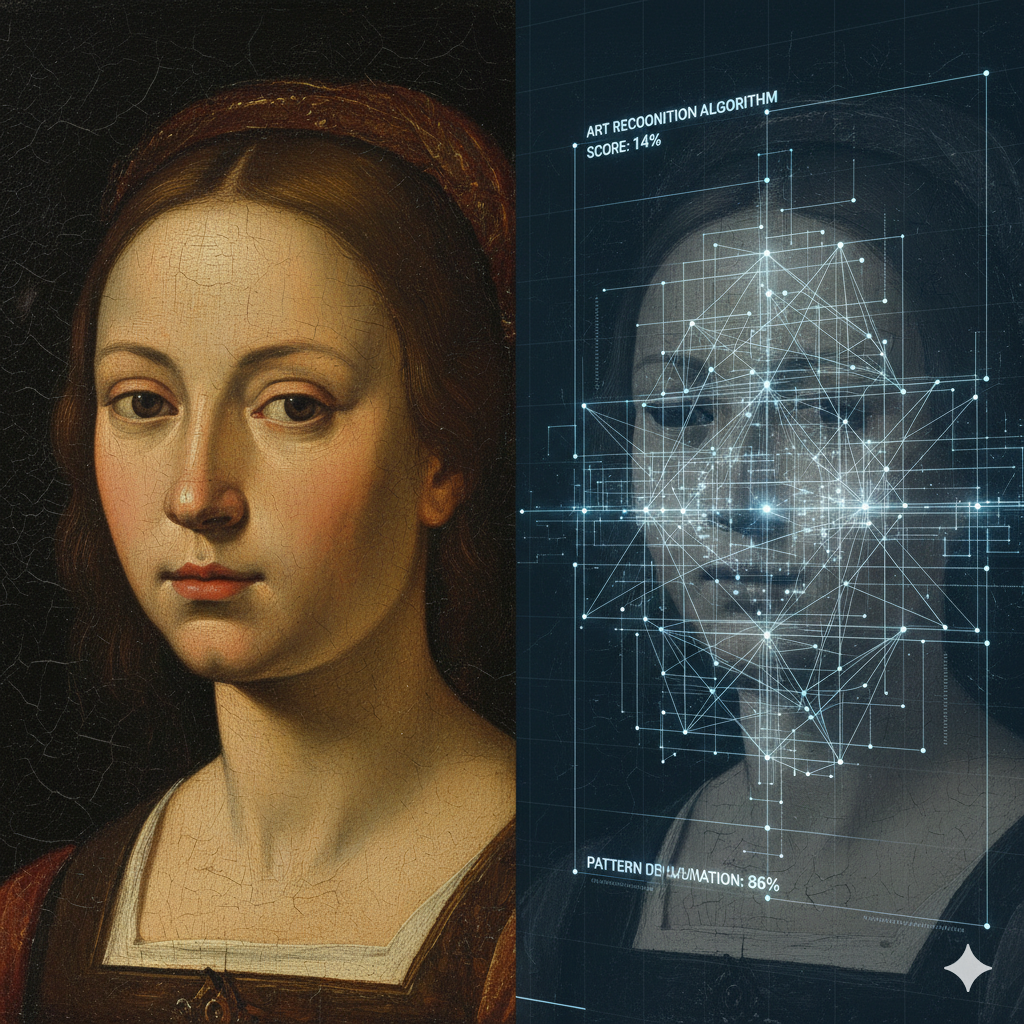
The Algorithm of Attribution
In the high-stakes world of art attribution, a new arbiter has arrived: the algorithm. Recent AI analysis has sent shockwaves through the industry, casting doubt on long-accepted masterpieces by Jan van Eyck. But as a painter, I find myself asking: can a digital scan truly capture the 'battlefield' of a canvas? While the experts use technology to validate lucrative labels, they often overlook the physical reality of the studio—the messy, inconsistent, and deeply human process that no machine can truly map. Is AI settling the score, or is it just providing a new veneer for old lies?
Why do we care about authenticity anyways?
Artificial intelligence is now entering the high-stakes arena of art attribution, attempting to settle age-old debates with cold, hard data. A recent report in The Guardian details how AI analysis has cast significant doubt on two versions of Saint Francis of Assisi Receiving the Stigmata, long attributed to the Flemish master Jan van Eyck. The Swiss company Art Recognition used brushstroke analysis to determine that the Philadelphia Museum of Art’s version was “91% negative” for Van Eyck’s hand, while the Turin version was “86% negative.”
 The Arnolfini Portrait: The Benchmark
The Expert’s Blind Spot
The documentary The Lost Leonardo (2021) serves as a perfect cautionary tale for this phenomenon. It chronicles the "discovery" and $450 million sale of the Salvator Mundi, a painting whose attribution to Leonardo da Vinci remains highly contentious. Watching the film, one sees how easily "truth" becomes secondary to power and profit. From my perspective, in the Salvator Mundi, certain passages, such as the hands, show a master’s touch, while others obviously lack the finesse of a genius. Yet, experts and dealers pushed the narrative until the price tag became too big to fail.
This highlights a fundamental issue: I’ve always believed that to truly identify a master’s work, one must have at least a minimal understanding of how to hold a brush. Art historians are notoriously prone to over-interpreting aesthetic choices. For example, they often attribute a sitter’s expression to "narcissism" or "arrogance," whereas an artist knows that we frequently adjust features simply to make the subject look better. We don’t want to paint ugly people. I have also lost count of how many times I’ve had to explain basic media and process to an art historian. I don’t need a spectrometer to see how an image was built; I use my eye and my experience. This just points out how certain aspects of the art world treat art like a science where they can label and categorize things into neat little boxes.
The Flaw in the Machine
 Salvator Mundi: A Narrative of Profit
The Battlefield of Creation
This leads to a larger question: Why does the name on the frame matter more than the quality of the work? The answer is simple: investment. If we valued art for its innate qualities—the "shimmering light and supernatural clarity"—then the culture's obsession with attribution would vanish. Maybe this is the most positive thing AI is going to do. When everything can be made by anybody, maybe the “anybody” will become less relevant.
There is also another silver lining. If AI can reduce an artist’s work to a replicable algorithm, it inadvertently defines what art we value as a whole. Maybe we will learn to see that creativity is usually not a standardized process; it is a much messier, like a battlefield. It is the mess of the studio, the constant pivot through mistakes, and the search for a path through the "battlefield" of a canvas.
AI might help experts validate lucrative, inaccurate attributions by providing a veneer of scientific certainty. But for the artist, it serves a different purpose: it proves that the soul of a painting lies in the parts that can’t be calculated—the grit, the struggle, and the human inconsistency that no algorithm can truly map. For me, AI has clarified where the real value is in art and I can easily say it’s not in the easily recognizable patterns of brushstrokes. It’s obvious to most people that the value of art is going to shift in the near future, but it is less clear for most where it will land. Wherever it lands, I have an idea that attribution will not be the winner.
Where did all the Picture Frames Go?
Why Modern Art deleted the Picture Frame

The picture frame, for centuries, served as more than a mere border; it was a threshold. It demarcated the artwork as a separate reality, a "window" into another realm. This realm was not merely a reflection of the material world, but often symbolized the heavenly or transcendental. From gilded Baroque extravaganzas to the simple elegance of Neoclassical moldings, frames played a crucial role in how art was perceived and valued, often investing the image with a sense of sacredness or elevated importance. However, the advent of modern art saw a significant departure from this tradition, with artists increasingly abandoning or radically reinterpreting the frame. This shift reflects profound changes in artistic philosophy, the role of the artwork, and the relationship between art and the viewer.
One of the primary reasons for the frame's decline lies in modern art's rejection of illusionism and the embrace of materiality. Traditional frames often enhanced the illusionistic depth of a painting, emphasizing its function as a window onto a scene, particularly a window that might depict an idealized or divine reality. Modernist movements, however, sought to break down this illusion. Cubism, for example, fragmented and flattened pictorial space, drawing attention to the canvas as a physical object. Artists like Picasso and Braque were more concerned with the formal elements of art—line, shape, color—than with creating a convincing representation of reality or a symbolic gateway to the divine. In this context, the frame became a superfluous barrier, separating the artwork from the very materiality it sought to celebrate.
Furthermore, the rise of "art for art's sake" liberated artists from the constraints of patronage and traditional subject matter. No longer bound to depict historical narratives or religious scenes for wealthy clients, artists explored abstraction, emotion, and subjective experience. This newfound freedom extended to the presentation of their work. The ornate frames that had once signified status, value, and a connection to a higher power became irrelevant, even contradictory, to the radical newness of the art itself. Artists sought a more direct and unmediated relationship with the viewer, and the frame was perceived as an obstacle to this immediacy.
The changing role of the artwork also contributed to the frame's diminishing importance. As art moved out of the private salon and into the public museum, its function shifted from decoration and status symbol to a more democratic and educational one. The emphasis was on the artwork itself, not its surroundings. Moreover, movements like Minimalism further stripped art down to its essential elements, rejecting any extraneous ornamentation. A simple, unframed canvas or a raw, industrial sculpture became the epitome of artistic purity.
In conclusion, the disappearance of the traditional picture frame in modern art was not merely a stylistic choice but a fundamental shift in artistic philosophy. It reflected a rejection of illusionism, a celebration of materiality, a newfound artistic freedom, and a changing relationship between art and the viewer. The artwork was no longer primarily a window into a transcendental realm, carefully contained and separated from reality, but rather an object in its own right, existing in and engaging with the space of the viewer.
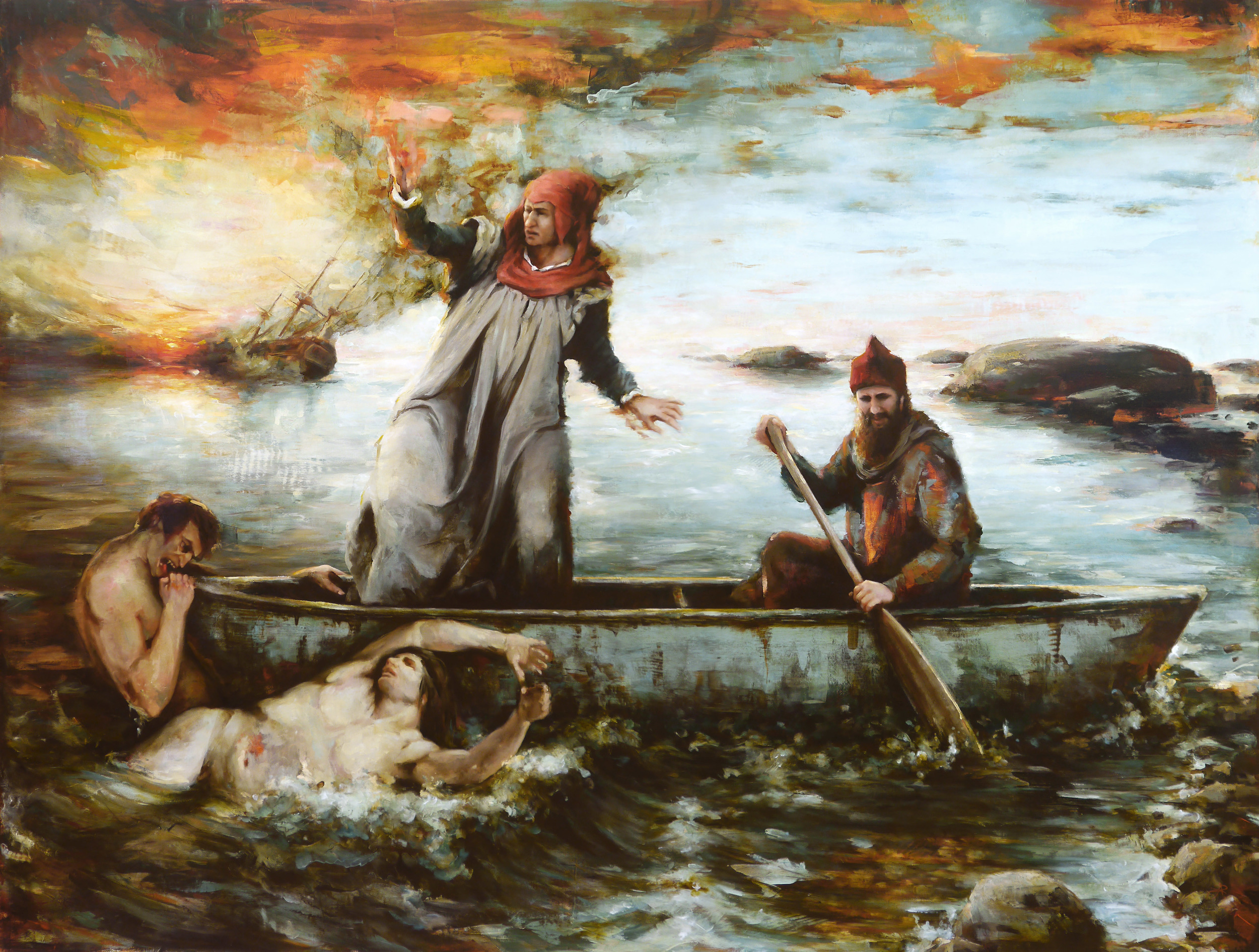
Transcending mere Representation
Joshua Adam Risner's art seeks to capture a vital "living presence," influenced by Tonalism and Inness, while his allegorical works explore his understanding of reality through a blend of historical and contemporary symbols, creating timeless yet relevant images.
My artistic practice is driven by a desire to create paintings that transcend mere representation, aiming instead to capture a vital and enduring presence. This pursuit is informed by two key artistic categories that shape his approach to both form and content.
Tonalism
The first body of work is the result of my desire to create paintings that reveal a living presence. I drew inspiration from iconography as well as the work and writings of George Inness. Inness said that “the true end of art is not to imitate a fixed material condition, but to represent a living motion.” The intent behind every mark I make is to give life to an idea, to instill a living presence within each painting. My hope is that life is always evident in the work I create.
Allegory
Within that context my artwork is also the material representation of the process within me that seeks to understand reality. This is an ongoing process of discovery that is never completely realized. My search takes shape in both concept and form through a juxtaposing of contemporary and historical symbols and techniques. The result is allegorical images that look like they are from the past, but speak a language that could only come from the present. I consider them to be amalgamations of the entirety of human history, culminating from the past and filtered through the present.
In conclusion my art seeks to capture a vital "living presence," influenced by Tonalism and Inness, while his allegorical works explore his understanding of reality through a blend of historical and contemporary symbols, creating timeless yet relevant images.
Artist reaches to the past to connect with the present

Eugene Delacroix observed, "What moves men of genius, or rather what inspires their work, is not new ideas, but their obsession with the idea that what has already been said is still not enough." This sentiment resonates deeply with Michigan based fine artist Joshua Adam Risner, who readily admits to feeling like an artist misplaced in time.
"I've always felt a profound connection with past masters like Delacroix, Raphael, and Rembrandt," Risner explains. "These artists built upon the vast knowledge of those who came before, each adding their unique contribution. In our contemporary rush for novelty, I believe we often undervalue the rich insights gained from understanding established ideas."
Embracing his lineage as an oil painter, Risner meticulously researches traditional techniques, not merely to replicate them, but as a foundation for his own experimentation. He embodies this dedication by mixing his own paints, crafting his frames, and frequently preparing his canvases using age-old methods. "Emulating the styles of master artists allows me to grasp not only their techniques but also their artistic intentions," he notes.
While Risner's paintings possess a timeless quality, he firmly believes they hold relevance for the present. "Before modernity," he explains, "artistic symbols were understood through shared cultural and religious conventions. My work, however, layers contemporary personal meaning onto these traditional symbols, creating a more complex and holistic interpretation of reality.
"My aim as an artist is to contribute to the ongoing artistic dialogue, not to discard the past," Risner states. He contrasts this approach with a perceived contemporary trend in art where irony, skepticism and deconstruction often drive the work, often serving political agendas. Risner consciously avoids these "destructive" paths, choosing instead to follow the tradition of artists who sought to enrich their artistic heritage rather than dismantle it, artists that sought beauty with the hope of inspiring others toward it.

Three Rabbits

Three Rabbits, Oil on Linen Panel, Created by Joshua Adam Risner
Captured with a high-resolution scan for exceptional accuracy, this oil painting is part of a small series focused on a simple, earthy palette. This limited color range emphasizes value contrast, an area I consider a strength in my work, and encourages a more symbolic interpretation than a full-color depiction. This approach is something I plan to explore further.
The painting features a tranquil, almost otherworldly figure, likely a young woman, in muted browns and whites. She gently holds a luminous, geometric object, her soft gaze fixed upon it, suggesting quiet contemplation or a mystical connection.
Three rabbits accompany her, each with a distinct presence: a dark one behind, a white one near her lap, and a brown one at her feet. These animals lend an allegorical feel, hinting at nature, vulnerability, or a symbolic relationship with the figure.
The abstract, textured background of swirling whites and pale blue creates a dreamlike atmosphere. A radiant gold halo behind her head adds a spiritual or symbolic layer. The overall impression is one of quiet beauty, inviting reflection on the figure's inner world and her connection to the glowing object and the gentle creatures around her.


Ive's Portrait Exhibition
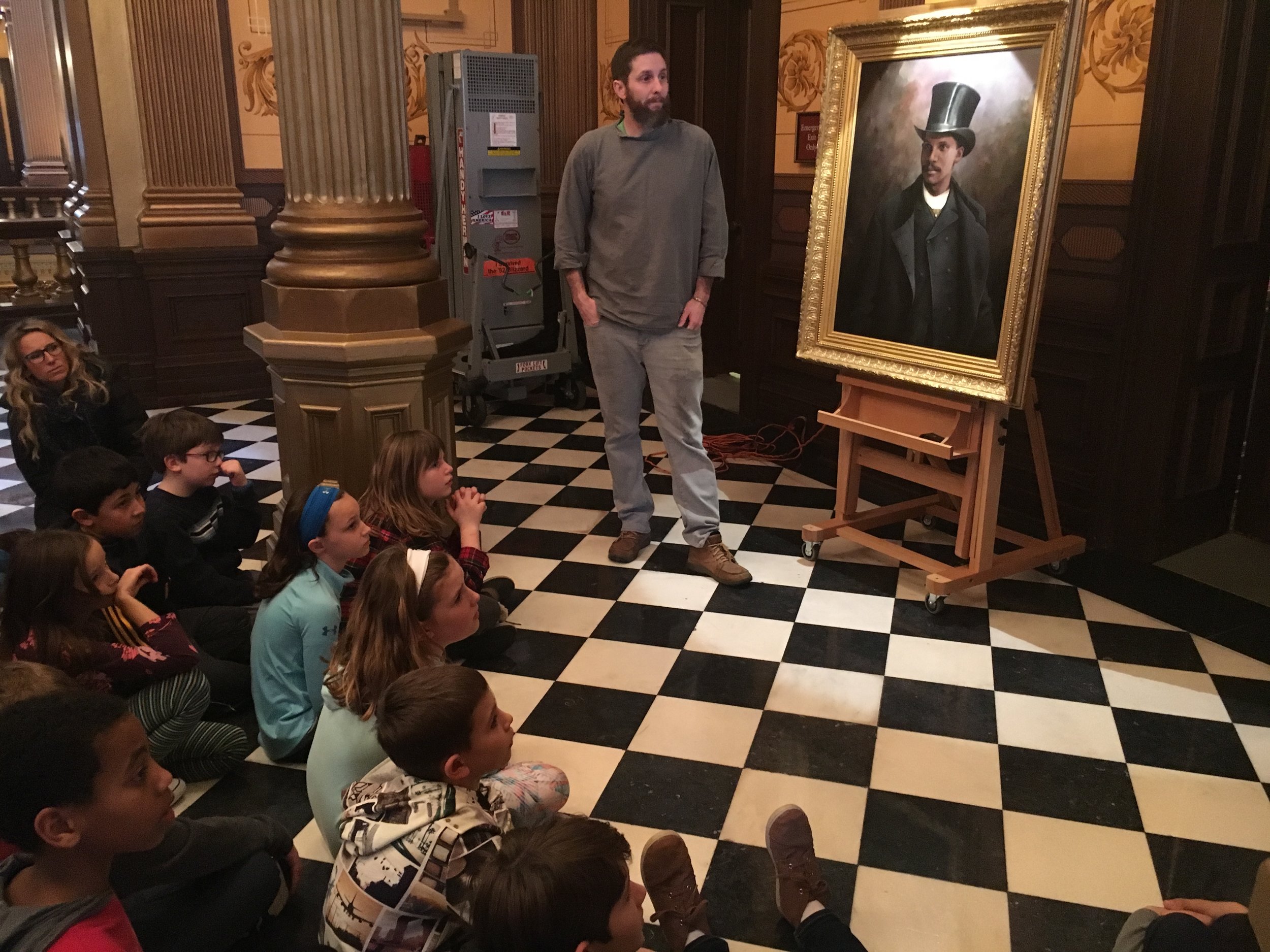
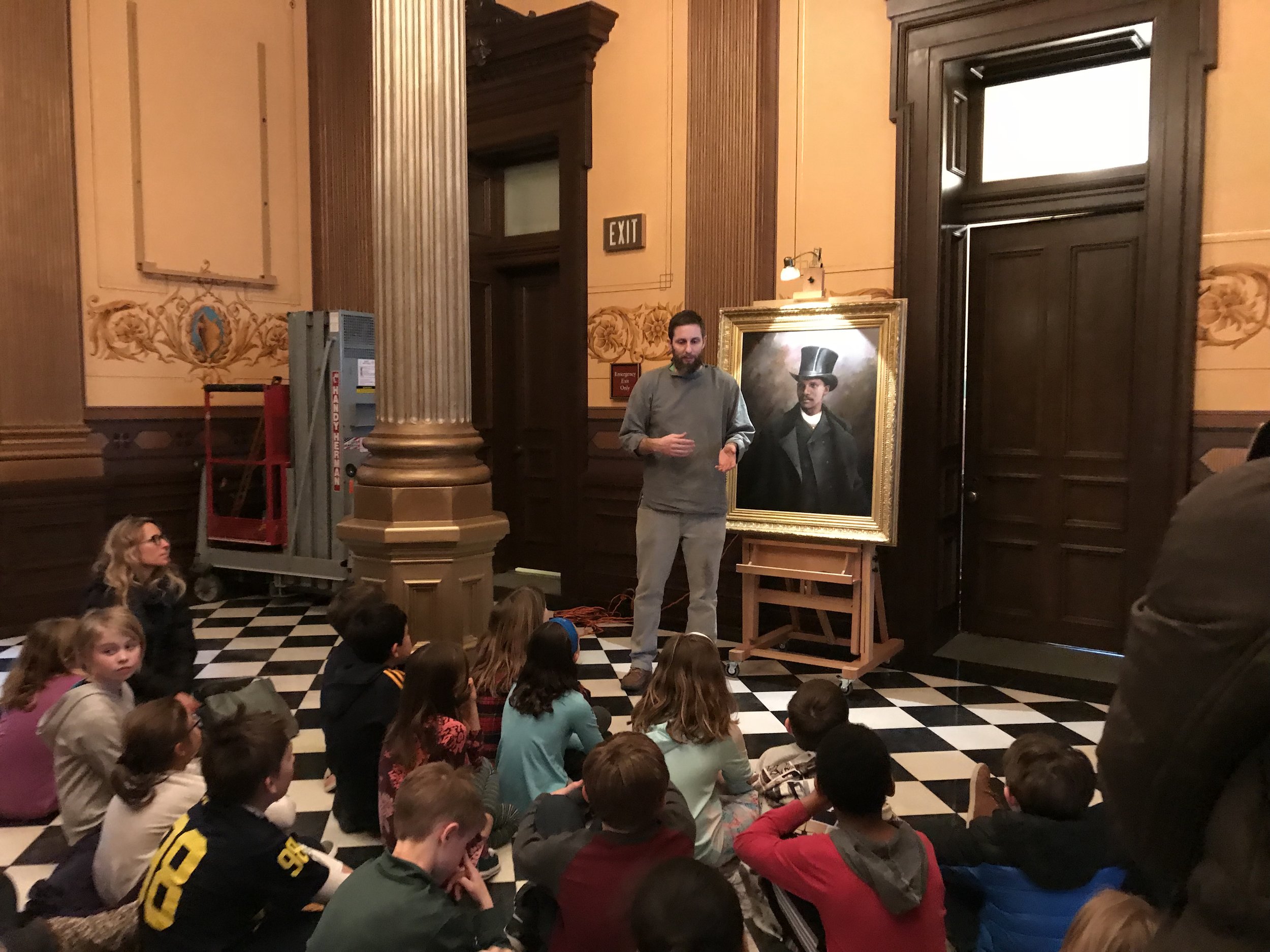
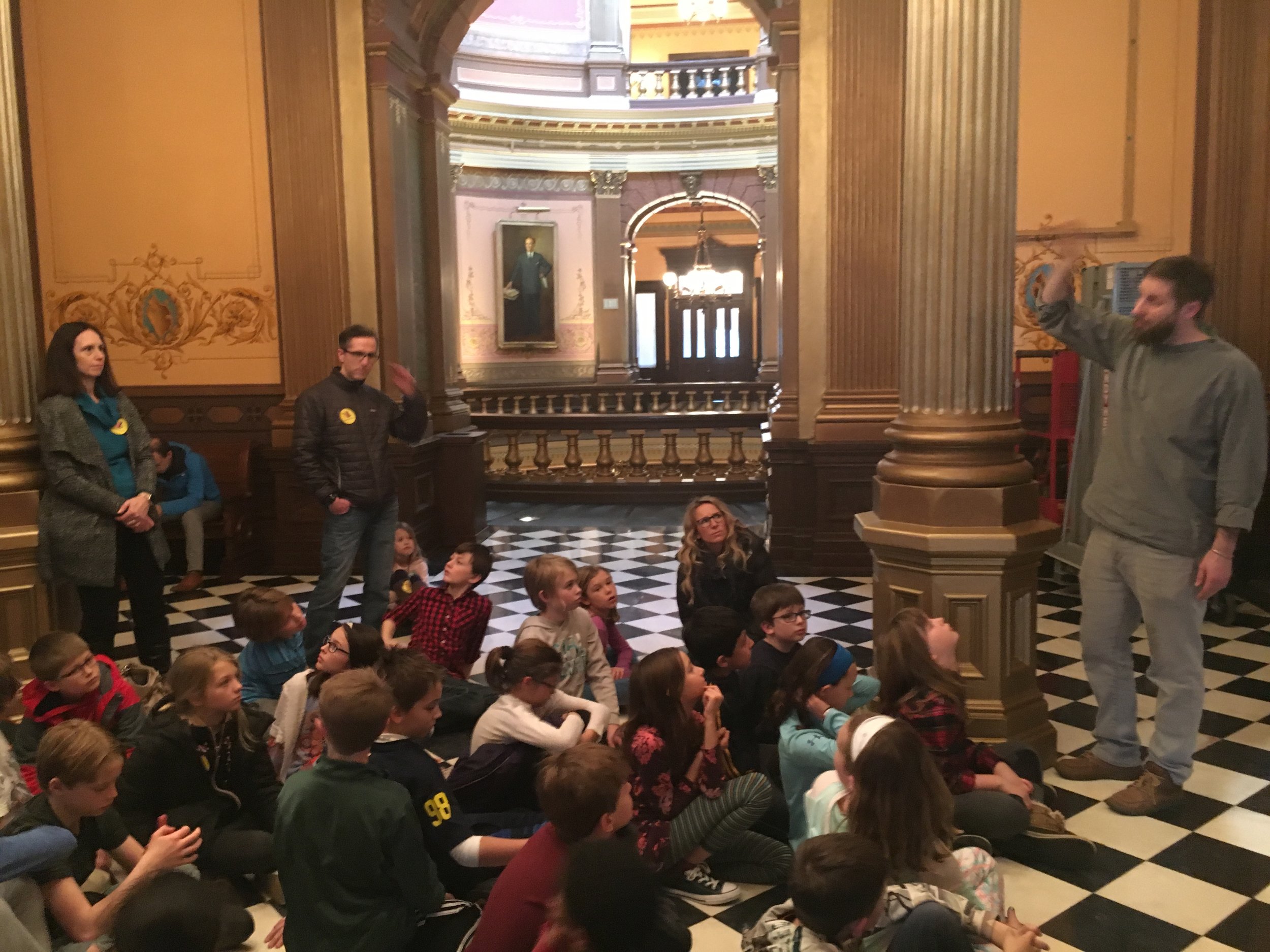
I recently wrote a short essay about a couple paintings I conserved for the capitol.
https://capitol.michigan.gov/post/exhibit-opening---behind-the-canvas-a-fathers-presence


Archeology of Allegory
The reputation and role of allegory has fluctuated throughout its long history. It has gone from being a valuable mode of interpretation for poets and philosophers to a manipulation tool for politics and preachers. For the past two centuries, due in part to its insistence on looking backwards and reliance on historical knowledge, allegory was condemned “as aesthetic aberration or the antithesis of art”. However, in the recent past allegory has re-emerged as a viable mode of exploration. This begs the question, what has changed that has allowed allegory to re-emerge? To answer this question a brief look back at the history is required. The goal of this exploration into allegory is to reveal the stimulus for its fluctuation, as well as what makes it still relevant today.
The reputation and role of allegory has fluctuated throughout its long history. It has gone from being a valuable mode of interpretation for poets and philosophers to a manipulation tool for politics and preachers. For the past two centuries, due in part to its insistence on looking backwards and reliance on historical knowledge, allegory was condemned “as aesthetic aberration or the antithesis of art”. However, in the recent past allegory has re-emerged as a viable mode of exploration. This begs the question, what has changed that has allowed allegory to re-emerge? To answer this question a brief look back at the history is required. The goal of this exploration into allegory is to reveal the stimulus for its fluctuation, as well as what makes it still relevant today.
Follow this link to read more.
ArtPrize 2015
This is a 7'x5' Oil on Canvas that will be on display at Devos Convention Center During ArtPrize 7. It is about 75% done. I look forward to getting it framed up.


I think I'm done

Sojourn, Oil on Canvas, 66" x 84", 2015
I believe this painting is finally finished. I hope that Mr. Delacroix is happy with it. It will be on display for my graduate exhibition in May. For me it represents the end of one phase of a long journey and the start of a new one. And so it begins again!
"What moves those of genius, what inspires their work is not new ideas, but their obsession with the idea that what has already been said is still not enough."
Eugene Delacroix

Another Under-painting, Oil on paper, 44"x33"
I think I am going to title this one Flight or Fight.

Magic Box, Oil on Paper, 44" x 30"
This one took on a life of its own. It's not exactly what it started out to be, but that's the magic of painting.

